Customer Journey Map
Four Figma boards with variables. Arabic and English, light and dark.
What is a customer journey map?
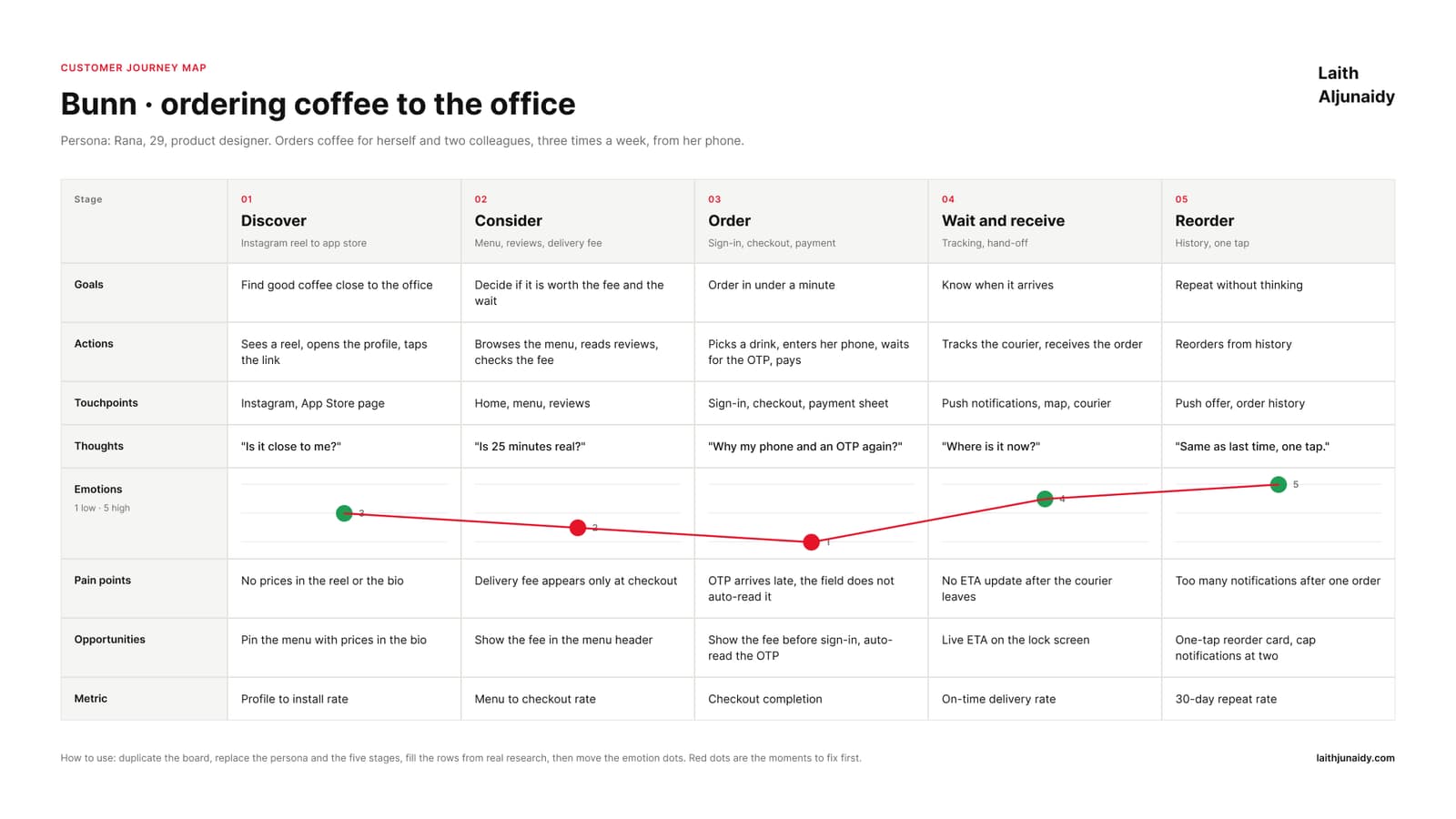
A customer journey map traces the customer's path from the first ad to the product in hand. Stages run across the top. Rows underneath record the customer's goals, actions, touchpoints, and thoughts, an emotion score from 1 to 5 for each stage, and the pain points, each paired with an opportunity and a metric.
- downloads273
- Files7
- LanguagesEN and AR
- FormatsFigma and PDF
- Updated
What is inside
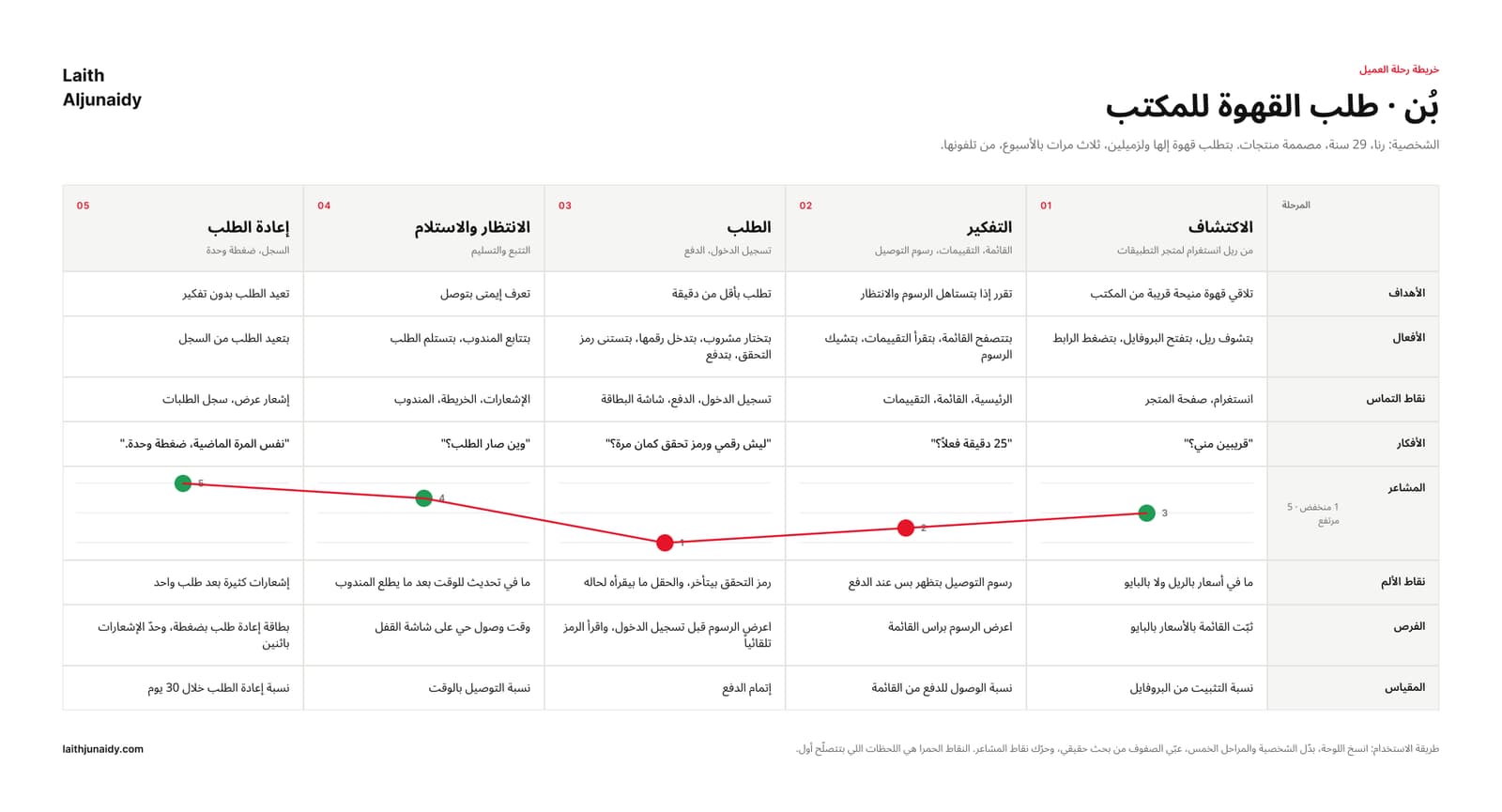
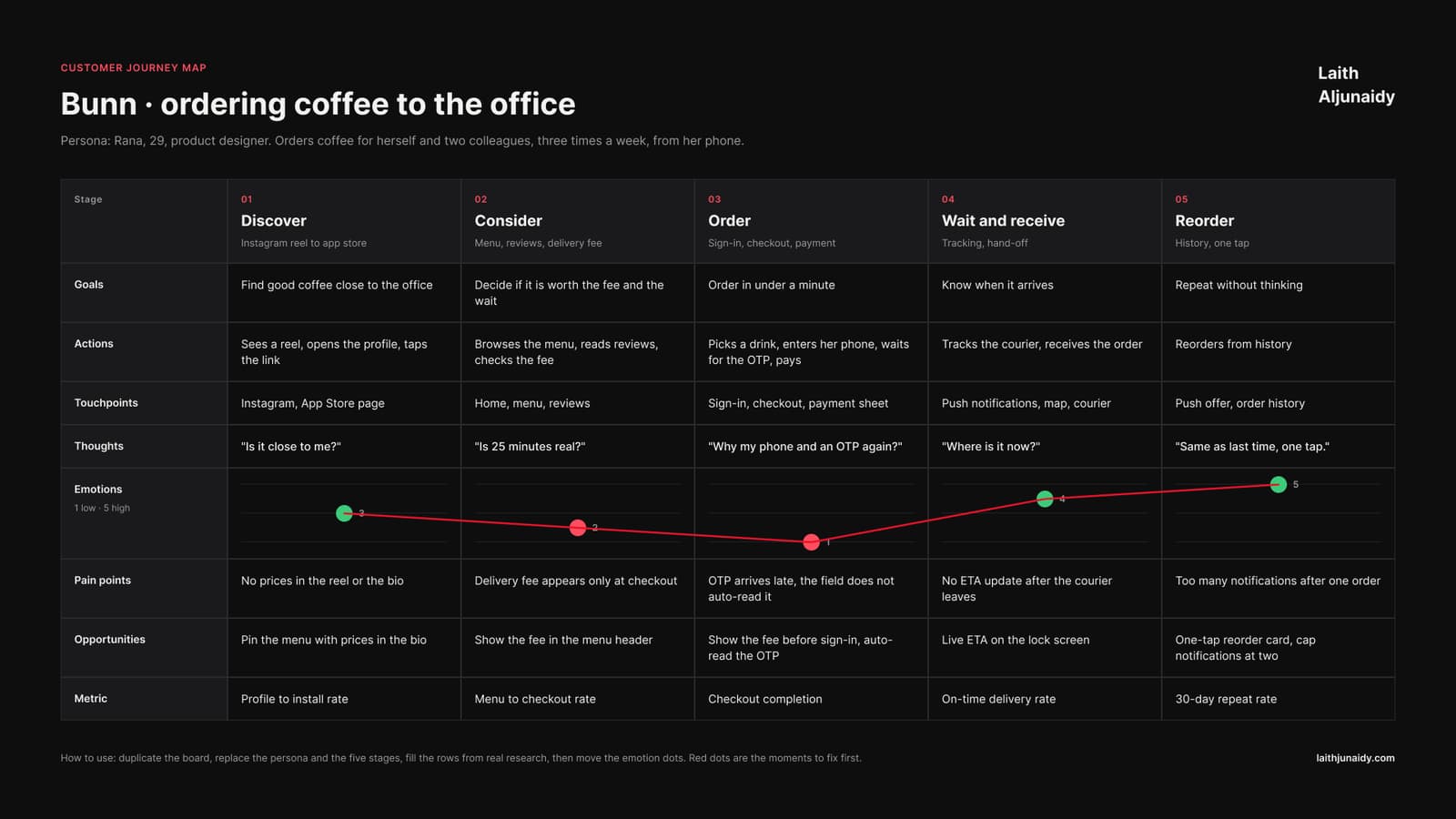
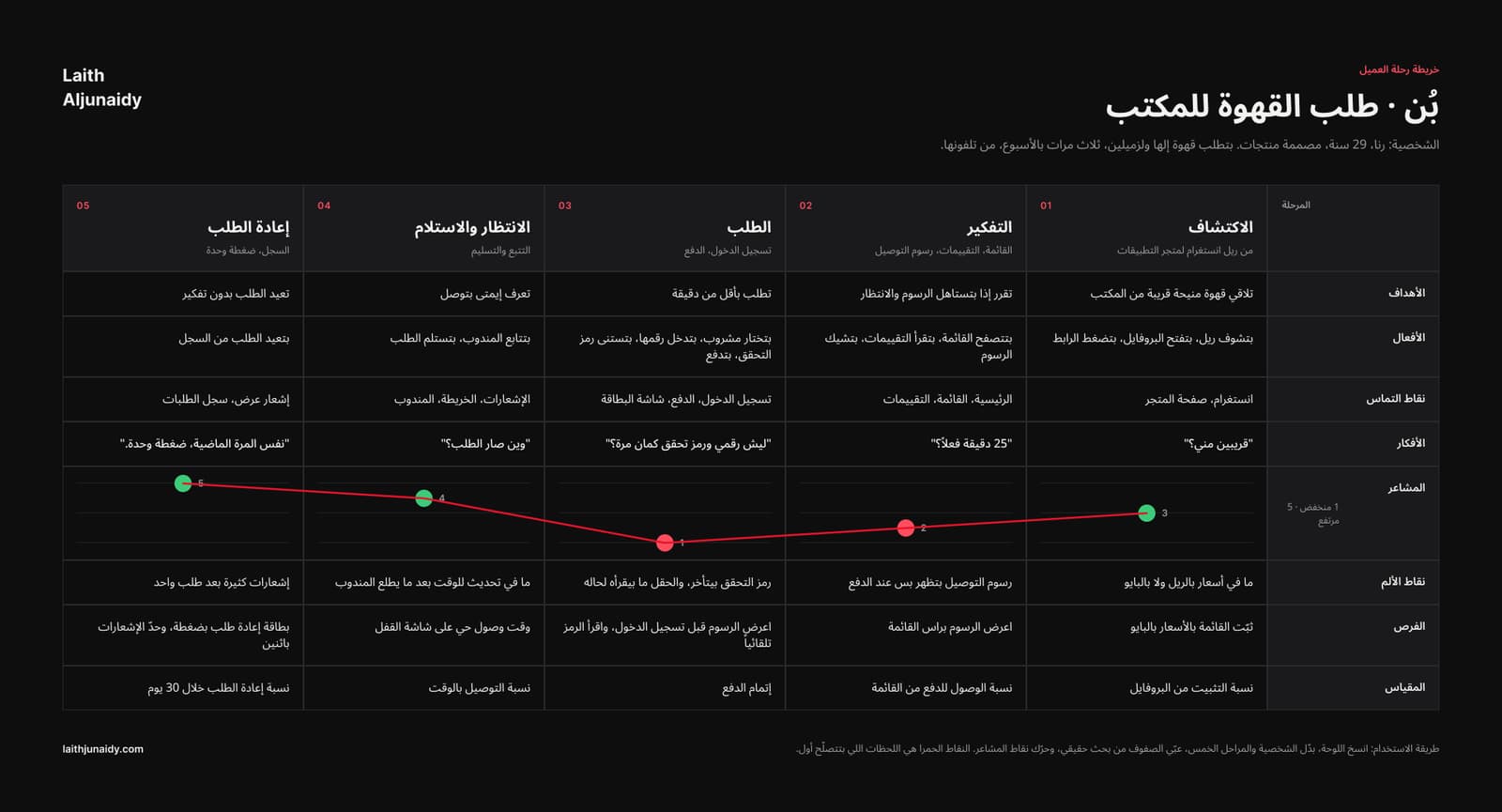
The Customer Journey Map is a free Figma template by Laith Aljunaidy that maps the customer's path from the first ad to the product in hand. Five stages across the top, rows for goals, actions, touchpoints, thoughts, an emotion curve scored 1 to 5, and pain points paired with opportunities and a metric each. One Figma file with four pages, English and Arabic, light and dark, on one variable collection, plus a 5 page PDF guide. Free on Gumroad. The Pro edition, 10 dollars, adds five Claude prompts, a facilitation guide, a second worked example, and a Claude Code skill.
Everyone on the team owns a screen. Nobody owns the twenty minutes between the ad and the product in the customer’s hand, which is exactly where she is lost.
What is on the Customer Journey Map board?
The Customer Journey Map board is one Figma canvas with four parts, built in 2026 with auto layout so every cell grows as you type:
- The stage header. Five numbered stages across the top, each with a name and one line saying what happens in it. Replace all five, they are the shape of your journey and not a fixed set.
- Goals, Actions, Touchpoints, Thoughts. Four rows. What she wants at this stage, what she does, what she touches to do it, and what she is thinking in her own words.
- Emotions. A row scored 1 low to 5 high, with a dot per stage on a live curve. Low dots are red, high dots are green, so the moments to fix first are visible from across a room.
- Pain points, Opportunities, Metric. Three rows. Every pain sits in the column where it happens, every opportunity answers a pain, and every opportunity carries a metric so the fix can be checked later.
What changes when you use the Customer Journey Map?
The Customer Journey Map template is a fix for six common habits in how teams run this step. Each of the 6 pairs below shows the habit first, then what the template puts in its place. For example, the template turns a flow that starts at the app into a journey that starts at the ad.
- Before: A flow that starts at the app.
After: A journey that starts at the ad. - Before: Feelings described in a paragraph.
After: A curve from 1 to 5, one dot per stage. - Before: Everybody owns a screen.
After: Somebody owns a stage. - Before: Pains listed with no place attached.
After: A pain in the column where it happens. - Before: Opportunities with no number behind them.
After: A metric row under every opportunity. - Before: An English map with Arabic pasted in.
After: A Levantine map built right to left.
What is in the Customer Journey Map download?
The free Customer Journey Map download is one Figma file with four pages, English light, English dark, Arabic light and Arabic dark, on one variable collection, plus a 5 page PDF guide, made in 2026 with Figma variables. The Pro edition costs $10 and adds five Claude prompts, a facilitation guide, a second worked example and a Claude Code skill.
- FIG The template. One Figma file, four pages: English light, English dark, Arabic light, Arabic dark, all on one variable collection. Auto layout throughout, so every cell grows as you type.
- PDF The guide. 5 pages: the four boards, a five step how to use.
- PDF, MD Pro. Five Claude prompts: fill it from my notes, critique it, Arabic edition, turn it into insights, push it to Figma.
- PDF Pro. The facilitation guide. A thirty minute session: what to ask, in what order, and how to close it.
- FIG Pro. A second worked example in a second market, as its own Figma file, so you can read the method instead of guessing at it.
- FOLDER Pro. The Claude Code skill. Point it at your notes folder and it fills the board, then writes it into your own Figma file by layer name.
Who is the Customer Journey Map for, and when should you run it?
The Customer Journey Map is for teams who keep fixing screens and keep losing the customer somewhere else. Build it once from real research, then reread it whenever someone proposes a feature, and check which stage it actually touches.
In practice, keep the Customer Journey Map beside the design file, where the team can reread it before each decision. Two editions. Free: the Figma file and the 5 page PDF guide. Pro, $10: adds the five Claude prompts, the facilitation guide, the second worked example and the Claude Code skill.
Paid
Go further with the paid kits
The nine templates at their Pro edition in one kit, or your design system as a folder Claude reads.